 Click to zoom
What are Spotify's new Prompted Playlists?
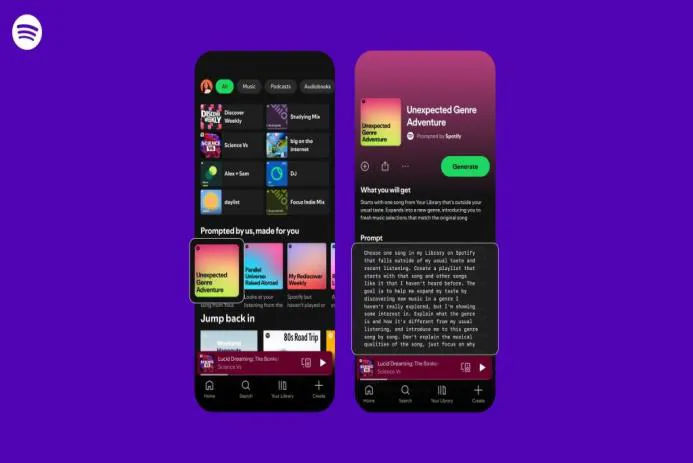
Spotify is quietly testing something I wish had existed sooner: Prompted Playlists, an AI-powered music tool that lets Premium users write normal, almost conversational prompts to build deeply personalized playlists. Rolled out in a limited beta for English-speaking Premium subscribers in New Zealand, this feels like the next step beyond basic algorithmic mixes—because it actually reads your full listening history and mixes that with broader world context to deliver playlists that match both your short-term mood and your long-term tastes.
How do Prompted Playlists differ from Spotify’s earlier AI playlists?
- Deeper listening history: Unlike some earlier features that leaned heavily on recent plays, Prompted Playlists can pull from your entire Spotify history—so those obsessions from five years ago still matter. That historical lens is huge if you cycle through phases.
- Longer, more specific prompts: You’re not limited to a few keywords. Write multi-part instructions—era, mood, activity, novelty—and the generator tries to honor all of them. Example: “High-energy pop and hip-hop for a 30-minute 5K run, then ease into relaxing songs for a cool-down.” That kind of prompt is exactly where tempo-aware playlists and activity-based playlists meet real-world use.
- World knowledge: The system factors in cultural context—trending shows, recent soundtracks, popular films—so you can ask for “music from this year’s biggest films that matches my taste” and get timely choices rather than stale picks. In short: it’s not just your catalog, itʼs the world around your catalog.
- Scheduling and refresh control: You can set refresh cadence—daily, weekly, or custom—so your mixes evolve as new songs drop or as your mood shifts. Want a daily running mix? Set it. Prefer a weekly discovery batch? Also there. It feels like finally having a DJ who remembers your calendar.
How to use Prompted Playlists—practical examples
The best way to learn is by example. Here are prompts that actually work and why.
- “Top artists from the last five years — include deep cuts I haven’t heard yet.” This blends familiarity (your favorite artists) with discovery (lesser-known tracks), a neat balance if you want comfort but also surprise. It’s a good prompt if you want to use full listening history to make better Spotify mixes.
- “High-energy pop and hip-hop for a 30-minute 5K run that keeps a steady pace before easing into relaxing songs for a cool-down.” This asks for tempo-aware playlist sequencing—warm-up, sustained effort, cooldown—useful for tempo-aware training or just not wanting jarring transitions. If you're asking, “how to create a running playlist with Spotify AI prompts?”, this is practically the template.
- “Music from this year’s biggest films and most-talked-about TV shows that match my taste.” Nice when you want culturally relevant tracks but filtered through your listening-history based preferences. It demonstrates how Spotify uses world knowledge to pick timely tracks.
Why the “full arc” of your tastes matters
The truth is, musical taste isn’t a single snapshot. Some songs are comfort food; others are phase-y experiments. Prompted Playlists try to respect that arc. In practice, that means fewer mismatched recs and more sessions that actually feel like you—nostalgic moments sprinkled alongside fresh finds. For me, that meant rediscovering a handful of deep cuts I’d forgotten about and enjoying them in new company—exactly the novelty vs familiarity mix you want. To be fair, it isn’t perfect; you still need to nudge it if you want very niche results.
Practical tips for writing better prompts
- Be specific about time and scope: Try phrases like “From my 2018–2022 library” or “my most-played indie artists.” That gives the generator a clear temporal or catalog constraint—how to create a Prompted Playlist on Spotify step-by-step 2025 starts with this. (Yes, little details like the year range actually help.)
- Specify activity and duration: “90-minute road trip mix with energetic peaks and mellow stretches” or “create a 30-minute running playlist with Spotify Prompted Playlists”—duration clues help with sequencing and pacing. Think of duration like telling a DJ the set length.
- Ask for novelty: Use “include deep cuts I haven’t heard” or “50% new songs I haven’t played” to nudge discovery-heavy outcomes. Saying “include two new songs per sprint” is a neat trick for interval sessions.
- Refine iteratively: Start broad and tighten: “Too mellow—make the middle section more upbeat.” Prompt refinement for music AI is a real thing; think of it like tweaking a DJ’s instructions mid-set. This also answers “How do I write prompts to get better Spotify playlists?”—refinement is the secret sauce.
- Request niche content explicitly: If you want indie or niche music, say so: “prioritize indie or underground artists” to counter bias toward popular content. People often forget to say the word — niche — and the model defaults to mainstream unless told otherwise.
How Spotify communicates recommendations
Each Prompted Playlist includes short explanations of why tracks were chosen so you can see the logic. That little transparency—algorithm transparency in music apps, if you will—helps you learn what phrasing moves the needle. And if you’re unsure where to start, Spotify supplies starter prompts to get you going, which is helpful when you wonder “What are Spotify Prompted Playlists and how do they work?”
Where this fits in the industry trend
Spotify isn’t alone. Platforms are handing users more control over recommendations: Instagram’s “Your Algorithm” tool, Bluesky’s algorithm swapping—these moves reflect a shift to let people sculpt feeds instead of blindly consuming them. Prompt-based music curation is part of that: more context-aware music curation, fewer one-size-fits-all mixes. If you care about personalized music discovery features, this is where the industry’s heading—more user-led personalization, more transparency, and more room for active discovery.
Potential privacy and UX considerations
- Data scope: Since the feature uses full listening history, ask: how long is that data stored, and who can access it? Check Spotify’s privacy docs—it’s worth being explicit about what listening-history based recommendations mean for your data. People often ask, “Are Spotify Prompted Playlists private and is my history stored?”—good question; read the policy.
- Bias toward popular content: World-knowledge signals can skew results toward mainstream tracks. Counter it by explicitly requesting indie or lesser-known artists if you want more niche discovery. It’s a small trade-off: timely picks vs underground finds.
Case study (hypothetical): A runner’s experience
Meet Jane (not her real name, but you get the idea). She built a Prompted Playlist for intervals: “45-minute interval run—5-minute warm-up, six 3-minute sprints with 2-minute recoveries, cool-down; energetic EDM and hip-hop that match my top artists, include two new songs each sprint.” It kept her on pace, the tempo-aware sequencing matched the intervals, and two new artists stuck. That’s the sort of personalized outcome you can expect when prompts are precise about activity and novelty. Real people will use this for training, commutes, and those weird mixed-mood late-night sessions.
What to expect next
For now, Prompted Playlists are beta, English-only, and limited to New Zealand. Expect broader language support, smoother UX for composing multi-part prompts, and maybe collaborative or shared playlist integration down the line. And yes—people will ask immediately: is it coming to my country? Probably, but timelines vary. A good practical FAQ to keep in mind: how to get Prompted Playlists if I'm not in New Zealand? Short answer: wait, or watch for broader rollouts.
Key takeaways
- Prompted Playlists give listeners more control: Use natural-language prompts to create playlists tailored to mood, activity, time period, or discovery goals.
- They leverage full listening history: That helps blend nostalgia with discovery in a way that feels less jarring.
- Refresh cadence and prompt refinement: Schedule playlist refreshes and iterate on phrasing to get the desired balance of novelty vs familiarity. You can schedule daily or weekly playlist refreshes on Spotify and tweak from there.
- Industry trend: This is part of a broader move toward transparent, user-controlled algorithms across apps.
Honestly, telling a service exactly what you want—rather than guessing through menus—feels liberating. If you’re a Premium user in the beta region, try a few prompts, tweak them, and note which wording yields the best mixes. Ask for deep cuts, specify tempo, and don’t be afraid to demand less mainstream tracks. You might just find a new favorite, or at least a playlist that finally gets you.

Further reading: check our guide to AI Christmas photo generator 2025. Learn more about AI tools in apps like this in our feature Google AI Pro free & more about prompt-based playlist generators in our overview of AI-native apps.
Thanks for reading!
If you found this article helpful, share it with others